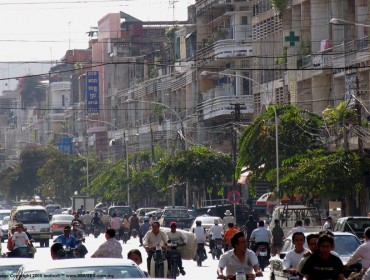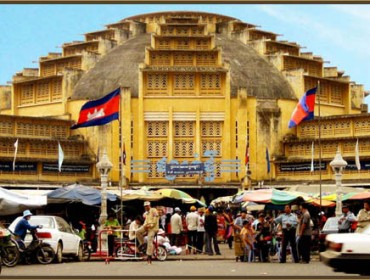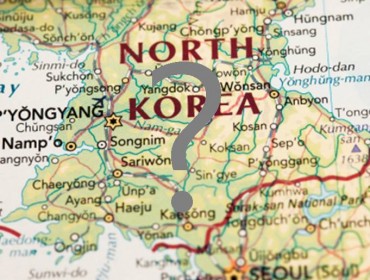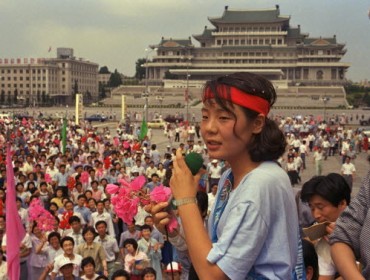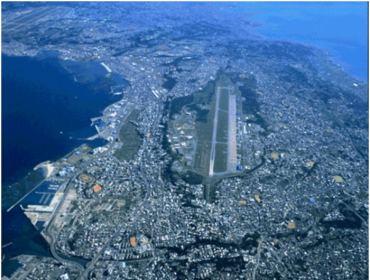


By Andrei Lankov for 3WM Stalinist regimes love their capitals. A capital is usually a very special place. It is extolled by court poets in their lengthy odes. Its cityscapes (well, what is supposed to be their cityscape in the ideal world, imagined in the works of propaganda arts) are depicted by the nation’s best [...]
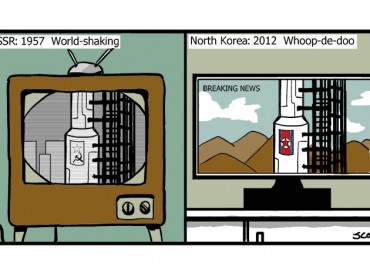
Toon by Lee Scott, words by Iwazaru After the embarrassing failure of North Korea’s Unha (the galaxy) 3 missile last Friday morning, officials in the North waited four hours to inform the journalists inside the country to cover the event, and others surrounding the 100th anniversary of founder Kim Il-sung’s birth, that the reports they’d [...]
By Tom McGregor at China Daily
Some Westerners incorrectly assume that China should only be viewed according to its political doctrine. They raise fears over its rapid economic development by claiming Beijing is pursuing sinister motives. China seeks peace, not war; alliances, not enemies; so it seems apparent that the nation must promote “soft power” to overcome commonly held misperceptions.
The four great classics of Chinese literature – Romance of the Three Kingdoms by Luo Guanzhong, Outlaws of the Marsh by Shi Nai’an, Journey to the West by Wu Cheng’en and A Dream of Red Mansions by Cao Xueqin – hold the key to a more comprehensive understanding of the Chinese mindset. The characters and plot-settings were written centuries ago, but the themes of love, conflict, family, crime, business, justice and politics remain relevant even today.
By Lee Scott
As many of you may know, a major election is coming up on Wednesday, April 11. Not only is it a day off for many of us, the election itself is something that the often-times frenetic campaigning makes us aware of even if we don’t care about the vote. How does Korean style election campaigning differ from the style you are accustomed to in your own home country? What do you think of the early-morning speaker trucks blaring music and campaign slogans in your neighborhoods, or the mobile stages parked at major intersections with rival candidates’ platforms being presented simultaneously, often accompanied by middle-aged (and sometimes older) ladies, decked out in their candidate’s colors and doing “that dance” that they all seem to know? How about those same women parading around the sidewalks in packs?
By David Wills
A few weeks ago, a couple of articles popped up on Google News that brought the name “Ieodo” once again to the attention of the world. Although admittedly there wasn’t much substance to these articles and they probably only went to print because it was a slow news day, it was enough to bring a collective groan from Korea’s expat community, and doubtless there were a few mentions of the “new Dokdo”, as yet another pissing contest continued between South Korea and one of its neighbors.
It appears South Korea has the national equivalent of Short Man Syndrome (this despite its population being taller than people in either of its big neighbors – China and Japan). It is sandwiched between powerful countries with bigger populations, more military might, and who’ve always had a greater influence over matters of global importance. The same can also be said of North Korea, whose brash actions and needless aggression are a painful cry not just for attention, but to inform the world that it has power and should not be ignored. History has not been kind to the Korean civilization, and it has been invaded and isolated for most of its existence. Yet in a remarkably short period of time, the southern half hauled itself from war-torn poverty to astounding affluence; and not just that, but it has become one of the richest nations on earth, sending its much vaunted Wave around the world to spread word of its new position. Koreans can be justifiably proud of their country’s progress.
By Iwazaru
As the Nuclear Security Summit 2012 roars into action today, some might wonder what all the ado is about. COEX, according to one friend who had to teach there this morning, was a “clusterf*ck” given all the security gates, the closure of Samseong Station, and the general heightened level of security. The real buzz began on Sunday, March 25, when President Obama visited the DMZ for the first time and peered across the border into a rather barren North Korean landscape. Then came his speech Monday morning at Hankuk University of Foreign Studies where he spoke of the importance of the securing nuclear dangers around the globe and “a world without nuclear weapons.”
Can’t You Hear Me Knocking? Don Kirk on China’s Refugee Dilemma
From the Scene, Politics 10 comments!By Donald Kirk
The Chinese by now must be getting the message. How long can they pretend not to hear the shouting and singing from all those people on the steps of the church across the street from their embassy around the corner from the Blue House and the Gyeongbuk Palace in central Seoul. Don’t tell me that row of police buses lining the street in front is blocking all the sound waves.
Ok, granted I didn’t see any windows opening in the beautiful modern building to which the Chinese moved their embassy from the historic Myeongdong site, now under construction as a much bigger, more modern establishment. Nor did I see any sign of movement in front of the embassy or inside the glass windows.
Still I’ve got to believe the Chinese are quite aware by now that sending poor bedraggled North Koreans, who’ve swum or walked or paddled across the Tumen or Yalu Rivers into China, back to North Korea is really a bad idea. It’s not just that the Chinese look like cruel collaborators with an oppressive regime. The problem is they look so dumb, so unhearing and downright inhuman.
By Andrei Lankov for 3WM
What is the image of North Korea in the mainstream western media? It seems that it is too easy to generalize. North Korea according to this image is a country of goose stepping female soldiers, violent anti-American propaganda posters and of course, starving farmers. There is no doubt that both anti-American posters (often of ridiculous bellicosity) and goose-stepping female soldiers (often of impressive beauty) are both present in the North. However in the last few years, one would have to look hard to find any significant number of starving farmers or for that matter, starving city dwellers. North Koreans don’t eat well, and by the internationally accepted standards they are malnourished. But few, if any of them have starved to death in the last five or so years.
KJI Dead, Chinese Pres. Refuses to Speak to Pres. Lee, Small Group from South Heads North—What’s Next?
From the Scene, Korean Life, Politics 5 comments!By Iwazaru and Peter Ward
What comes next is where it gets very interesting. Successor designate Kim Jong-un is now in the unenviable position of having to preside over his father’s funeral and then attempt to consolidate his grip on power. What follows is seemingly likely to take one of three paths.
Kim Jong-un, with or without the help of his aunt Kim Kyong-hee and her husband Chang Song-taek may succeed in consolidating his power. This might not happen straight away. He may not simply leap into the shoes of his father and start going on tours of the country, giving disciplinary speeches to the high-level cadres that turn up in the newspaper and be the centre of a fanatical personality cult all of his own. The above mentioned has already begun in the North—he was reported to have gone on tours with his father several times, and has his own (still nascent) personality cult. He may take his time, behind the scenes consolidating his power, whilst in public mourning his father’s passing, much like Kim Jong-il did in the three years after the death of his father.
Vaclav Havel: Playwright, Poet and Dissident Supreme Moves on to his Final Castle
From the Scene, PoliticsBy Mizaru
I took my first real teaching job in Prague at the Gymnasium Jana Nerudy, and at any chance I got, I used to read and drink at The Golden Tiger with Jiri Pavel. He was an original signer of the Czech civil rights initiative Charter 77 and revealed of himself, “I was a minor poet in a major time.” I didn’t have to mention anything much about my admiration of Havel for Jiri often revealed,
“Yes I drank bear with him 20’s of times.” And after we had a few Pilsners together he confided,
“We all wanted to be Havel but not just anybody could be for everybody like him.”
He had his own part of a table at “The Tiger” and when I met him on late weekday afternoons he always asked, “So have you met Havel yet?” Never a question of the obvious like do you want a beer but always had I met Havel yet. It was our inside joke. And inside jokes are a natural contour in the Czech personality. Jiri was mildly fascinated at all the Americans who were turning up in Prague in the 90’s, but really he knew the score, “Czech beer, Czech architecture, Czech women: now everyone can enjoy.”
Toon by Lee Scott and words by Iwazaru
With the election of Park Won-soon, the liberal independent candidate, in the October 26 mayoral election, the debate over free lunches, free college tuition and other welfare policies has dominated policy-making discussions around Seoul and the country.
One side that has emerged lately is that the increased cost of the free lunches is taxing local governments who have to allocate larger percentages of welfare spending to the free lunches away from other programs.
Expat English Teachers in Seoul Public Schools to be Axed en Masse
EXPAT LIFE, Politics 28 comments!By Iwazaru

Over recent years the growing trend in Korea’s ESL education has pointed toward a preference for Korean English teachers in both private and public schools. The administrators of schools prefer to have teachers who can work within the system, removing any sort of language and cultural barrier and, as new reports and polls are now showing, parents and kids prefer a Korean teacher over an expat (see here for a detailed list of sources).
Now, the Seoul government has taken heed and says it will show all expat English teachers in Seoul’s public high schools the door beginning in September of 2012.
By Yann Kerloc’h
I shot these images in Busan, Korea, on October 8th. Some filmmakers and people related to movies took buses to see the female worker Kim Jin-suk, who had been occupying a crane on the grounds of her factory, Hanjin, for more than 8 months (since January 6). She has since come down.
This event is a complex story to tell and I guess only Koreans will get what it is about without further information. In addition to the link above, see here for 3WM’s coverage of the issue.
By Stella Jang
Every time there is an important election, campaigns are held all over the country in order to encourage youths to vote. This kind of apathy towards politics is considered a serious problem since the very group of people from which some will have to be political leaders and the others will have to determine the country’s future by either supporting the leaders or criticizing them is alienating itself from reality. This way, only a few people who are deeply concerned about politics will take up the role, and the world of politics will become polarized by these extremists.
However, in order to get young people to vote and be interested in politics, politicians themselves must prove that the world of politics is not a place of incessant senseless battles. One of my friends pointed out that politicians must stop waging a war between the conservative and the progressive, but seek actual solutions to problems in reality such as the unemployment crisis or financial difficulties.
By Peter Ward
The Korean-American Free Trade Agreement (FTA) was first mooted and drafted under the presidency of former President Roh Moo-hyun. There are many things said about Roh: he was corrupt, he was a human rights lawyer with great oratory skills, a crusader against exploitation, an idiot (바보) in the good sense of the word—i.e., a noble idiot. One thing that was emblematic of his premiership and what came before it—and what is more broadly a part of the left in South Korea—is an economic and to a certain extent politically critical posture towards the United States. To be honest this is fairly justifiable in some regards. The United States has in the past made it its own business to intervene in a country’s political system in order to install interests (often rather unpleasant to the locals) friendly to Washington.


Recent Comments